
PCI DSS v4.0
PCI Data Security Standard (PCI DSS) is a global standard that establishes baseline technical and operational requirements to safeguard account data. The latest iteration of the standard, PCI DSS v4.0, is now accessible.PCI DSS v4.0 New Requirements
Requirement 1: Install and maintain network security controls
Network security controls (NSCs), including firewalls and other network security technologies, serve as enforcement points for network policies. They are responsible for regulating network traffic between various logical or physical network segments (or subnets) based on predefined rules or policies. While this function has traditionally been fulfilled by physical firewalls, it is now also achievable through virtual devices, cloud access controls, virtualization/container systems, and other software-defined networking technology.Requirement 2: Apply secure configurations to all system components
Malicious individuals, whether internal or external to an organization, often exploit default passwords and other vendor settings to compromise systems. These well-known passwords and settings can be easily obtained from public information. Implementing secure configurations for system components is crucial for reducing the vulnerabilities that attackers can exploit to compromise systems. This involves actions such as changing default passwords, eliminating unnecessary software, functions, and accounts, and disabling or removing redundant services. These measures collectively contribute to minimizing the potential attack surface and enhancing overall system security.Requirement 3: Protect stored account data*
It is important to refrain from storing payment account data unless it is absolutely necessary for the business's operations. Under no circumstances should sensitive authentication data be retained after authorization has been granted. If your organization maintains Primary Account Numbers (PAN), it is imperative to ensure that they are rendered unreadable. Additionally, if your company retains sensitive authentication data before the authorization process is completed, it is crucial to implement robust protection measures for this data as well.Requirement 4: Protect cardholder data with strong cryptography during transmission over open, public networks
In order to prevent unauthorized access, it is important to encrypt primary account numbers (PANs) when they are being transmitted over networks that can be easily accessed by malicious individuals, including untrusted and public networks. Malicious individuals often target misconfigured wireless networks and vulnerabilities in outdated encryption and authentication protocols in order to gain privileged access to cardholder data environments (CDE). To protect PAN transmissions, the data can be encrypted before it is transmitted, or the session over which the data is transmitted can be encrypted, or both.Requirement 5: Protect all systems and networks from malicious software
Malicious software, also known as malware, refers to software or firmware created to infiltrate or harm a computer system without the owner's knowledge or consent. Its goal is to compromise the confidentiality, integrity, or availability of the owner's data, applications, or operating system. Examples of malware include viruses, worms, Trojans, spyware, ransomware, keyloggers, rootkits, malicious code, scripts, and links. Malware can enter a network through various business-approved activities, such as employee email (e.g., via phishing) and the use of the internet, mobile computers, and storage devices. This can lead to the exploitation of system vulnerabilities.Requirement 6: Develop and maintain secure systems and software
Security vulnerabilities in systems and applications can allow criminals to access payment data. Many of these vulnerabilities can be fixed by installing security patches provided by the vendor. These patches quickly repair specific areas of the code. To prevent exploitation, it's important to have the latest critical security patches installed on all system components. Additionally, patches should be applied to less critical systems within a reasonable timeframe, based on a formal risk analysis. Applications should be developed using secure coding practices, and any changes to systems in the cardholder data environment must follow change control procedures.Requirement 7: Restrict access to cardholder data by business need-to-know
Unauthorized individuals could potentially access important data or systems due to ineffective access control rules and definitions. To prevent this, it's crucial to have systems and processes in place to restrict access based on necessity and job responsibilities. "Need to know" means granting access to the minimum amount of data required to perform a job, while "least privileges" means providing only the essential level of privileges needed for a job.Requirement 8: Identify users and authenticate access to system components*
To maintain security, it's important to assign a unique ID to each person who has access to ensure that actions taken on critical data and systems can be traced back to authorized users. These requirements apply to all accounts, including point-of-sale accounts, those with administrative capabilities, and all accounts used to view or access payment account data or systems. It's important to note that these requirements do not apply to accounts used by consumers (cardholders) unless otherwise stated.Requirement 9: Restrict physical access to cardholder data
Access to cardholder data or systems storing, processing, or transmitting cardholder data must be restricted to prevent unauthorized access or removal of data systems or hardcopies.Implementation Timeline
Below is the implementation timeline for PCI DSS v4.0.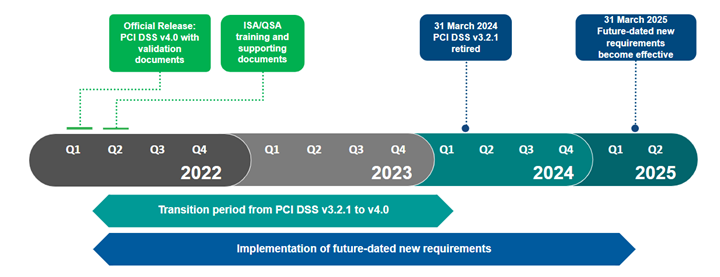 The PCI DSS v4.0 New Requirements Assessment Will Include:
- Initial Consultation and Scope Review
- Validation of new controls and relevant Documentation Review
- Comprehensive Gap Identification
- Designing an Actionable Roadmap
- Access to ControlCase’s groundbreaking Compliance Hub™ platform